If you spend most of your day sitting at a desk, you’re probably familiar with that stiff feeling in your neck, shoulders, or lower back. Maybe your legs feel heavy by the afternoon, or your energy seems to disappear after lunch. It happens to almost everyone who works on a computer for long hours.
The good news? You don’t have to wait until the evening to hit the gym. A few minutes of movement during the day can help your body feel much better. In fact, even five minutes is enough to wake up your muscles, improve circulation, and give your mind a quick reset.
The best part is that these exercises don’t need special equipment or a lot of space. You can do most of them right beside your desk without changing into workout clothes.
Why Short Exercise Breaks Matter
Sitting for hours slows down your body’s natural movement. Your muscles become tight, your posture starts to suffer, and you may even feel less focused.
Taking a short movement break every hour or two can help:
- Reduce muscle stiffness
- Improve blood circulation
- Ease neck and shoulder tension
- Boost energy levels
- Improve concentration
- Support better posture
You don’t need to work up a sweat. Just getting your body moving is enough.
H2: A Simple 5-Minute Desk Exercise Routine
Try these exercises one after another. Move slowly and comfortably without rushing.
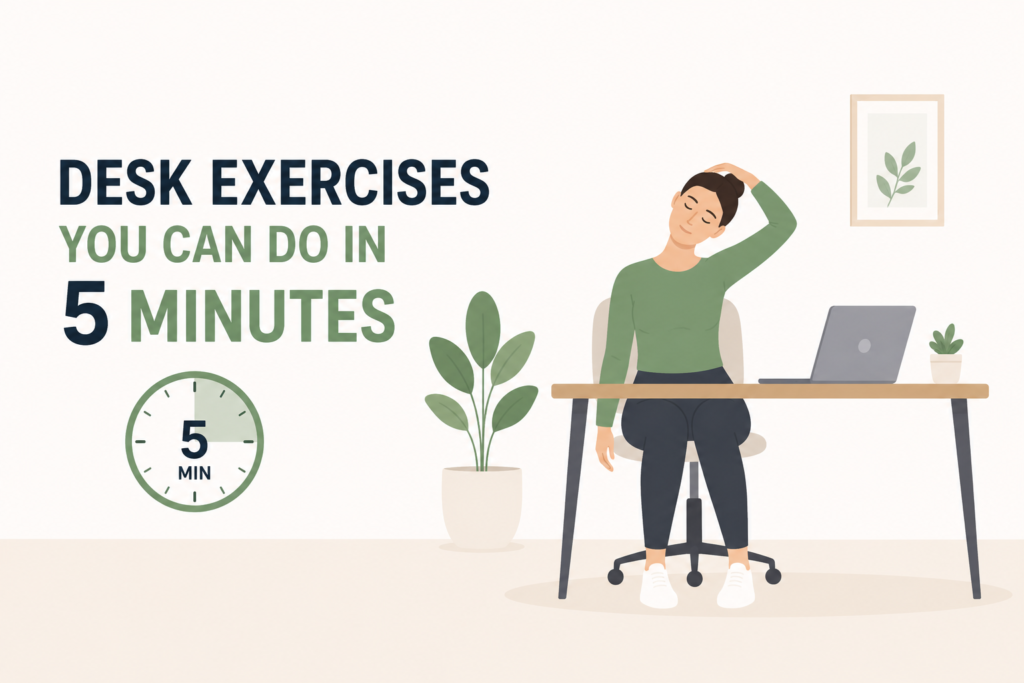
H3: 1. Neck Side Stretch (30 Seconds)
After staring at a screen, your neck muscles usually need attention first.
Sit tall and slowly tilt your head toward one shoulder. Hold for 15 seconds before switching to the other side.
Avoid pulling your head with force. A gentle stretch is all you need.
H3: 2. Shoulder Rolls (30 Seconds)
This is probably one of the easiest exercises, but it feels surprisingly good.
Roll both shoulders forward ten times.
Then roll them backward another ten times.
You’ll often notice your upper back feeling lighter almost immediately.
H3: 3. Seated Spinal Twist (40 Seconds)
This exercise helps loosen your back after sitting for long periods.
Sit upright with both feet flat on the floor.
Place one hand on the opposite knee and gently twist your upper body.
Hold for about 20 seconds before changing sides.
Remember, this isn’t a race. Slow movements work better.
H3: 4. Chair Squats (1 Minute)
Stand up in front of your chair.
Lower yourself until you’re just about to sit, then stand back up.
Repeat 10 to 15 times.
Your legs and glutes will definitely know they’ve been working.
H3: 5. Standing Calf Raises (30 Seconds)
Hold the back of your chair if needed.
Lift your heels until you’re standing on your toes.
Lower slowly.
Repeat 15 to 20 times.
It’s a small movement, but it encourages better blood flow in your legs.
H3: 6. Desk Push-Ups (1 Minute)
Place your hands on the edge of a sturdy desk.
Step back slightly.
Lower your chest toward the desk and push back up.
Aim for 10 to 15 repetitions.
It’s a simple way to wake up your chest, shoulders, and arms without getting on the floor.
H3: 7. Wrist and Finger Stretch (50 Seconds)
Typing all day can leave your wrists feeling tight.
Stretch one arm forward with your palm facing out.
Use your other hand to gently pull back the fingers.
Hold for about 15 seconds before switching hands.
Then open and close your fists several times to improve circulation.
H2: Little Habits That Make a Big Difference
H3: Stand Up More Often
It’s easy to lose track of time when you’re busy.
Try setting a reminder every hour to stand up, walk around, or stretch for a minute.
Those tiny breaks add up more than you might think.
H3: Keep Water on Your Desk
Sometimes we stay seated simply because we don’t want to interrupt our work.
Keeping a water bottle nearby encourages regular hydration. It also gives you a reason to get up and refill it throughout the day.
H3: Check Your Sitting Position
Your screen should be close to eye level.
Your feet should rest flat on the floor.
Try not to lean forward for long periods. Many people don’t even realise they’re doing it until their neck starts hurting.
H2: Make Movement Part of Your Work Routine
You don’t have to complete every exercise perfectly.
Some days you’ll only have time for a couple of stretches. Other days you might finish the entire five-minute routine. Both are perfectly fine.
The important thing is to avoid staying in one position for hours.
Think of these exercises as short breaks rather than workouts. They help your body recharge so you can return to work feeling more comfortable and focused.
Five minutes may not sound like much, but over weeks and months, those small breaks can make a real difference. Your neck feels less stiff, your back complains less often, and your energy doesn’t disappear quite as quickly during the afternoon. Sometimes the smallest habits are the ones that quietly improve your day the most.